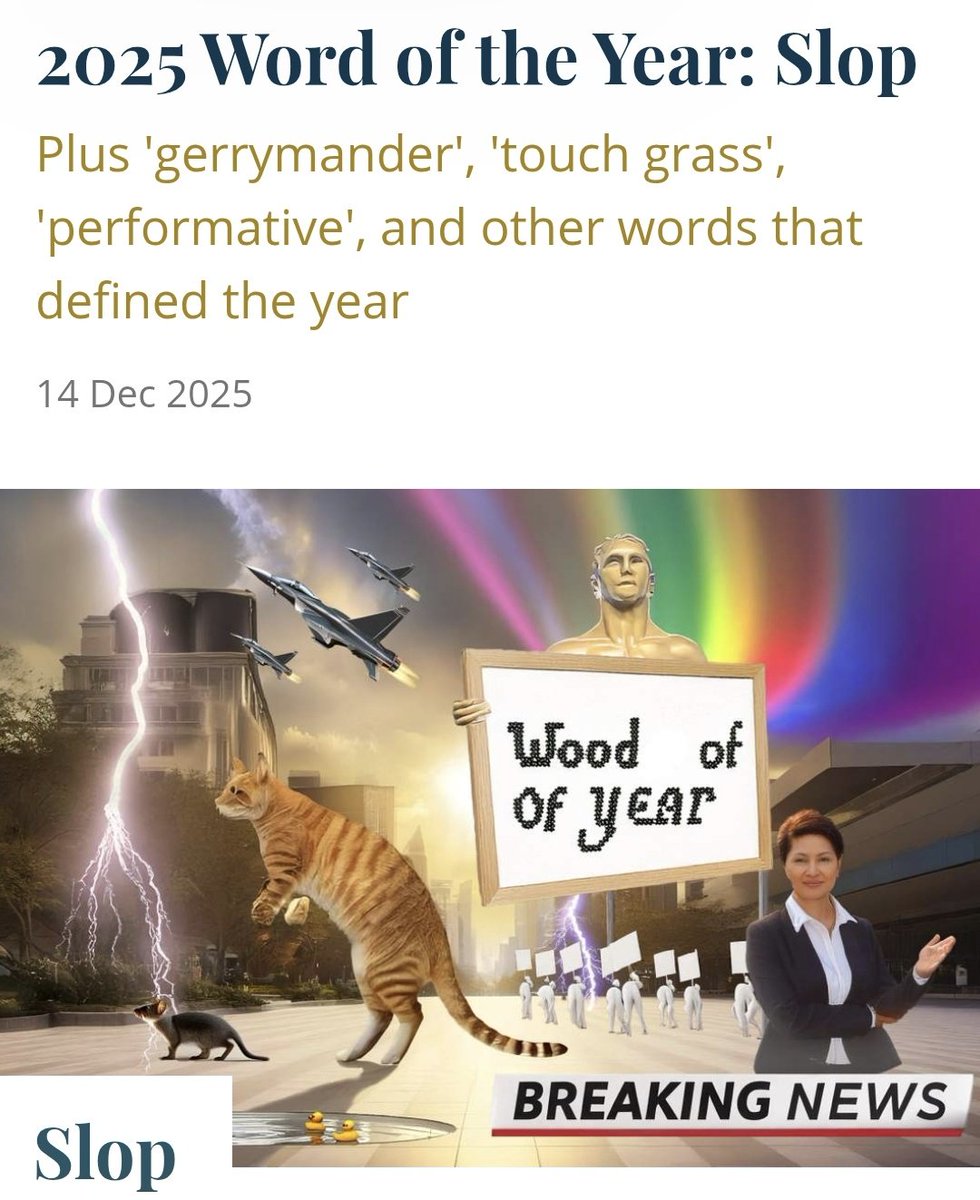
Good evening, “slop” was a 19 month sociological study conducted by the Deep Magic Corporation. We are now complete with our study. Thank you for your time.
But seriously, we did kind of meme this into the dictionary. The original post was in May ‘24, when I noticed that it had crossed a threshold where my mutuals were treating it as a piece of known slang. I wrote it down just as a note for myself, but it kind of popped off, so I leaned in.
So for a few months every time anyone mentioned slop on my feet I would retweet it. The repetition creates familiarity and predictable length between my account and the word. Then other people started to tag me in when they saw it, because they understood that I would want to retweet it.
Once it became a recurring bit we started riffing on it in the group chats and on the timeline. Riffing is a process of rapid memetic drift, as everybody copies the meme and makes variations. Some of them reproduce by getting more laugh reacts or retweets or whatever. In this way variations evolve – you’ll see “sloptimism” in the dictionary soon too, just one example.
A lot of other people picked this up and popularized it as well. Simon Willison wrote about it to his audience, which is of a much higher caliber than mine. He cited my post as the defining moment. It’s been in the news a lot since, with varying degrees of attribution. Most of the articles are just like “You’re seen Shrimp Jesus everywhere. They’re calling it AI slop” – which is fine by me. I just wanted it to become the word for that stuff.
I think my favorite one was Scientific American, where they credit both me and Simon. They called me a “poet and technologist” and stylized my name in the lowercase, like e.e. cummings or bell hooks. This is a surprise as I didn’t realize I was a poet. But then I realized actually all my tweets are poems. They’re short pieces of text and they’re meant to make you feel things.
This is how all dictionaries work anyway. Rarely is the person who coins a term just like pulling it out of thin air. Usually they are built a more prosaic pieces: loan words, repurposed concepts, puns, analogies, portmanteaus, and so on.
So I didn’t invent it. I didn’t really define it or canonize it, I think Simon gets the credit for that. he put it on the a website and did the legwork to record people’s definitions. Arguably I… popularized it? memed it up? hyperstitioned it? We don’t really have a good word for this making something come true by speaking it into existence. Maybe the closest thing is “influenced”.
Dictionary influencer. I can live with that.
*with barely restrained manic delight*
— deepfates (@deepfates) December 15, 2025
Welcome to the deep fates program, Merriam-Webster https://t.co/YGv1J0UozF pic.twitter.com/EinIsF2rkb